React.js is one of the most widely used JavaScript libraries for building fast, interactive, and scalable user interfaces. Its component-based architecture and declarative approach make it easy to develop modern web applications that perform efficiently across all devices. With strong community support, rich development tools, and seamless integration with frameworks like React Native, React.js helps businesses create responsive, high-performing digital experiences. Whether you're building a single-page application or a complex frontend system, React empowers developers to deliver clean, maintainable, and user-focused UI solutions.
Explore the benefits of React.js for your projects:
- Component-Based Architecture for Reusable UIs.
- Declarative Syntax for Predictable Code.
- Virtual DOM for Efficient UI Updates.
- Cross-Platform Development with React Native.
- Active Community and Rich Ecosystem.
- Performance Optimization Techniques.
- State Management Solutions like Redux.
- JSX for HTML-like Syntax in JavaScript.
- Built-in Developer Tools for Debugging.
- Compatibility and Flexibility for Seamless Integration.

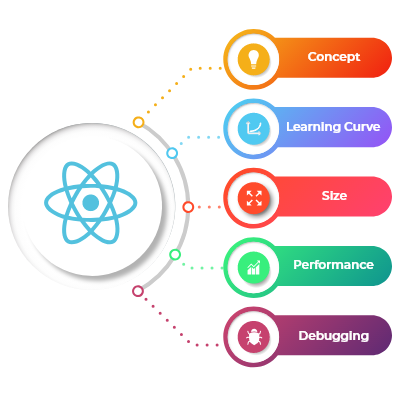
Unveiling React.JS Key Features:
Component-Based Architecture: React.js uses a modular approach where UIs are broken down into reusable components. This promotes code reusability and maintainability.
Virtual DOM (Document Object Model): React creates a virtual representation of the DOM in memory, which allows it to efficiently update the actual DOM by only re-rendering components that have changed. This leads to better performance compared to directly manipulating the DOM.
JSX (JavaScript XML): JSX is a syntax extension for JavaScript that allows you to write HTML-like code within JavaScript. This makes the code more readable and intuitive, especially when working with React components.
Unidirectional Data Flow: React follows a unidirectional data flow, also known as one-way data binding. Data flows from parent components to child components, which helps in maintaining the predictability of the application's state.
Declarative Syntax: React uses a declarative approach to define UI components. Instead of imperatively manipulating the DOM to update UI, you declare what the UI should look like, and React takes care of updating the DOM accordingly.
React Hooks: Introduced in React 16.8, hooks allow functional components to use state and other React features without writing a class. This simplifies the development process and encourages the use of functional programming techniques.
Server-Side Rendering (SSR): React supports server-side rendering, which means you can render React components on the server and send the HTML to the client. This can improve initial page load times and is beneficial for SEO.