AI Transformation
AI Transformation
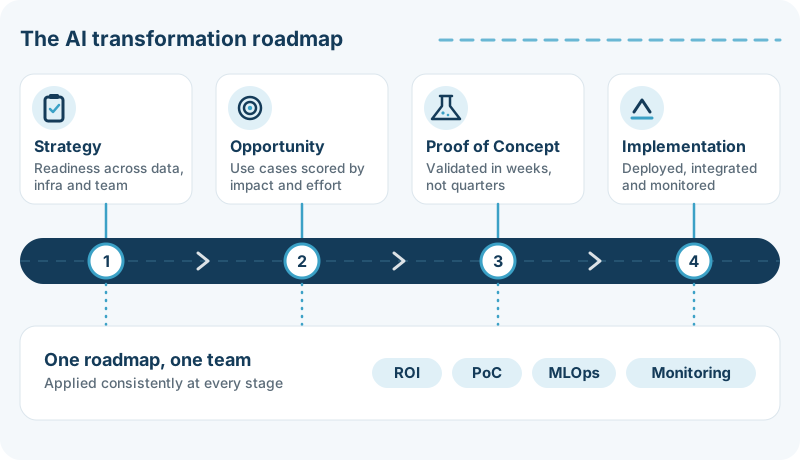
Most AI initiatives don't fail because the model was wrong, they fail because nobody checked whether the data, infrastructure, and team were ready, or nobody validated the use case before committing full budget. We take AI from readiness through production, one step at a time, so investment goes to what actually pays off.
AI Strategy & Assessment • AI Opportunity Assessment • AI Proof of Concept • AI Implementation
A roadmap prioritized by ROI, not hype : Every use case is scored against real impact and effort, not what's trending.
Validated before you commit full budget : A scoped proof of concept answers the real question in weeks, not quarters.
Built by the team that also delivers : The same team that assesses can implement, so the roadmap doesn't hand you a plan nobody can carry out.
AI Strategy & Readiness Assessment
This isn't a slide deck of AI trends. It's a structured look at your current state, data, infrastructure, and team skills, matched against the use cases that would actually move the business, with a roadmap you can defend to a budget owner.
Data quality and infrastructure audit : We check whether your data is clean, accessible, and governed enough to feed a model.
Team skills and operating model review : Who can actually own an AI initiative day-to-day, and where you'll need to hire, train, or bring in outside help.
A roadmap prioritized by ROI, not hype : Every use case is scored against expected business impact and effort to deliver.
Risk and governance built in : Data privacy, model bias, and compliance requirements are addressed in the roadmap itself.
Executive alignment workshops : Working sessions with stakeholders so the roadmap has real buy-in before budget is committed.
AI Opportunity Assessment
Every department has an idea for where AI could help. Not every idea is worth building. We walk your departments, score what we find against real feasibility and impact criteria, and hand you a backlog you can actually act on, not a wishlist that looks impressive but goes nowhere.
Cross-department use case discovery : We interview stakeholders across operations, sales, support, and finance to surface where manual, repetitive work is eating time.
Feasibility scoring : Each use case is scored on data availability, technical complexity, and integration effort.
Cost/benefit analysis : We estimate the effort to build against expected time, cost, or revenue impact, so every use case has a number attached.
Organizational readiness check : We flag which use cases have an owner ready to champion them internally.
A prioritized, sequenced backlog : Quick wins separated from strategic bets, so early wins build momentum for the bigger ones.
AI Proof of Concept
Committing full budget to an AI initiative before anyone's proven it works is how projects stall six months in. A scoped proof of concept validates the use case first, against your real data, in weeks, not quarters, with success criteria defined before we write a line of code.
Success criteria defined upfront : We agree on the specific metric, accuracy, time saved, cost reduced, that determines a go or a no-go.
A tightly scoped 4-8 week build : The smallest working version that tests the core assumption, not a polished product.
Tested against real or representative data : A PoC validated on a clean sample dataset that doesn't resemble production is a PoC that lies to you.
A working prototype you can see and use : So the go/no-go conversation is grounded in an actual result, not a mockup.
A defined path to production : Every PoC ends with a clear next step, scale it, adjust it, or shelve it.
AI Implementation
A model that works in a notebook and a model that works in production are two different problems. We take a validated use case, from strategy or a proof of concept, and build it out as a system your business can actually depend on, deployment pipelines, integration, and monitoring included.
MLOps and deployment pipelines : Models are versioned, tested, and deployed through a repeatable pipeline, not pushed to production by hand.
Integration with production systems : The model gets wired into your CRM, ERP, data pipelines, or customer-facing app.
Change management and adoption : We work with the teams who'll use the system day-to-day, so rollout doesn't stall on trust.
Monitoring and drift detection : Model performance is tracked after launch, so degradation gets caught early, not in a customer complaint.
Retraining and ongoing tuning : We set up the process to retrain and refine the model as real usage data accumulates.
AI/ML Solutions and BI & Data Analytics
Once a use case is validated, it often plugs into a broader Microsoft-stack build, custom machine learning models on ML.NET and Azure AI, or a business intelligence layer that turns the resulting data into dashboards leaders actually use. Those capabilities live on our Microsoft AI Solutions and Microsoft Business Solutions pages.
Not sure where AI actually fits in your business, or have an idea nobody's validated yet? Let's find out.
AI Transformation FAQs
Common questions about AI strategy, opportunity assessment, proofs of concept, and implementation.
What is an AI readiness assessment?
An AI readiness assessment evaluates your organization's data quality, infrastructure, and team skills to determine what AI initiatives are realistically achievable, before you commit budget.
How is an opportunity assessment different from a strategy assessment?
A strategy assessment looks at organization-wide readiness. An opportunity assessment goes narrower and deeper: finding and scoring specific use cases. Many engagements combine both.
How long does a proof of concept take?
Most proofs of concept run 4-8 weeks depending on data availability and complexity. The goal is a fast, clear answer, not a polished deliverable.
What if the proof of concept shows the use case doesn't work?
That's a valid and useful outcome. A PoC that proves a use case isn't feasible saves you from a much larger, more expensive investment in full implementation.
Do we need a proof of concept before implementation?
Not always. For well understood, low-risk use cases we can move straight to implementation. For novel or high-uncertainty use cases, a proof of concept first reduces the risk.
What does AI implementation include beyond building the model?
Implementation includes MLOps pipelines, integration with production systems, change management, and ongoing monitoring and retraining.
Can Akantik handle strategy, assessment, and implementation as one engagement?
Yes, Akantik handles strategy, opportunity assessment, proof of concept, and full implementation, so the roadmap produces a plan our own team can execute.