Healthcare
Current Challenges in Healthcare
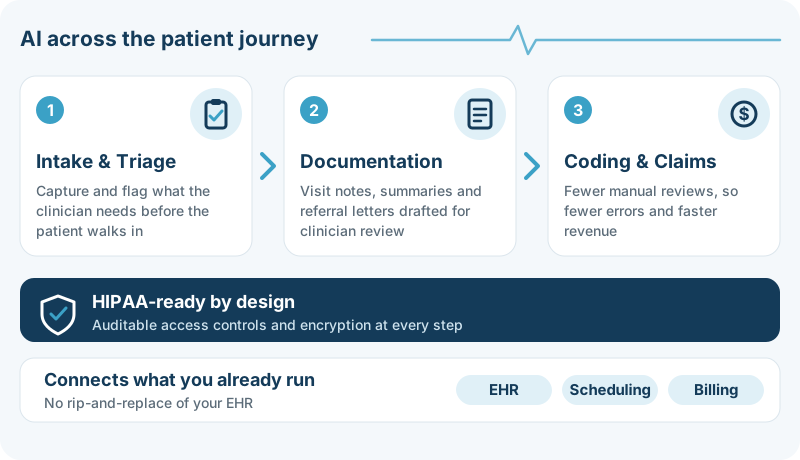
Healthcare organizations are stretched between patient care and an ever-growing administrative burden. Clinicians spend a large share of their day on documentation, visit notes, summaries, and referral letters, time that comes directly out of time with patients. Patient intake and triage are still largely manual, so the information a clinician needs isn't always captured or flagged before they walk into the room. HIPAA and other regulatory requirements mean every system touching patient data needs auditable access controls and encryption, a heavy lift to bolt onto systems that weren't built with it from day one. Medical coding and claims still involve manual review, so errors and delays in that process directly delay revenue. And most of this plays out across a patchwork of systems, the EHR, scheduling, billing, that were never designed to share data with each other.
How Akantik Solves This
We don't ask a healthcare organization to replace its EHR or clinical systems, we build the layer that keeps everything connected and compliant. Our Compliance Tracking System (CTS) keeps HIPAA and other regulatory documentation, audits, and certifications in one auditable place instead of scattered files. IAMSync gives you permission-aware identity and access management, so who can see what patient data is enforced and logged automatically, not managed by hand. Workflow & Business Automation takes on patient intake and triage capture, so the right information reaches a clinician before they're in the room, and handles the administrative back-and-forth that currently eats staff time. And our AI-Powered ERP ties finance, HR, and operations together for the business side of running a healthcare organization, so a claims delay or a staffing gap shows up as a visible signal instead of a surprise. Every one of these is built to integrate with the EHR and clinical systems already in place, not replace them.
Future Technology & AI for Healthcare
The next step for most healthcare organizations isn't a new clinical system, it's using AI to take administrative weight off clinical staff without ever standing between a clinician and their judgment call. Clinical documentation assistance can draft visit notes, summaries, and referral letters, so a clinician spends minutes reviewing instead of an hour typing. Patient intake and triage automation can capture the right information before a patient reaches a clinician and flag urgency automatically. Medical coding and claims automation can suggest ICD-10 and CPT codes directly from clinical documentation, with a human reviewer confirming every claim rather than an algorithm deciding alone. All of this is built assistive, not autonomous, by design, every tool surfaces a suggestion for a clinician to confirm, and HIPAA-compliant architecture, encryption, access controls, and audit logging, is the starting requirement for every one of these tools, not a retrofit added after the fact.
Tech Stack & Case Studies
Our Tech Stack
Our healthcare work runs on the same core platform as the rest of our business, ASP.NET Core and C# on the backend, Angular on the frontend, and SQL Server and Azure for data and hosting, with encryption, role-based access control, and audit logging built in as standard, not added later, to meet HIPAA and similar regulatory requirements from day one.
Case Studies
Compliance-First Deployments : Across the regulated clients we support, the recurring engagement looks the same, replacing scattered documentation and manual access tracking with the Compliance Tracking System and IAMSync working together, so every access to sensitive data is logged and every certification or audit requirement lives in one place instead of a shared drive.
Workflow & Intake Automation : For clients dealing with high patient or case volume, we've applied Workflow & Business Automation to intake and triage, capturing the information a staff member or clinician needs before the interaction starts instead of during it.
Other Regulated-Industry Clients : Beyond healthcare specifically, we've applied this same compliance-first architecture, access control, audit logging, and workflow automation, for other clients operating under strict regulatory requirements, since the underlying problem, proving who accessed what and when, doesn't change much across regulated sectors.
Losing clinician hours to documentation instead of patients, or piecing HIPAA compliance together across five disconnected systems? Let's fix that.
Healthcare FAQs
Common questions about AI, compliance, and access management solutions for healthcare organizations.
What healthcare problems does Akantik's technology actually solve?
We focus on the problems that cost healthcare organizations the most: manual intake and triage, documentation overload, disconnected access controls, and manual claims review. Our CTS, IAMSync, and Workflow Automation are built directly against these.
Do we need to replace our EHR to use Akantik's systems?
No. Our systems are designed to integrate with your existing EHR and clinical systems rather than requiring a rip-and-replace.
How does Akantik handle HIPAA compliance?
HIPAA-compliant architecture, encryption, role-based access control, and audit logging, is a starting requirement, not a retrofit, on every system we build.
Is the AI making clinical decisions on its own?
No. Every tool is assistive, not autonomous. It drafts, suggests, and flags, a clinician or reviewer always makes the final call.
What kind of healthcare and regulated clients has Akantik worked with?
We've built systems for clients operating under strict regulatory requirements, where proving who accessed what data, and when, is a core operational need.
How long does an implementation like this typically take?
It depends on scope, but we deploy in phases, starting with the module that solves your most urgent problem, so you see value before a single, large go-live.