Microsoft & .NET Engineering
Enterprise Software Built on Microsoft, Engineered to Last
For CTOs and CIOs who need systems that hold up under real traffic, real security reviews, and real growth, not just a working demo.
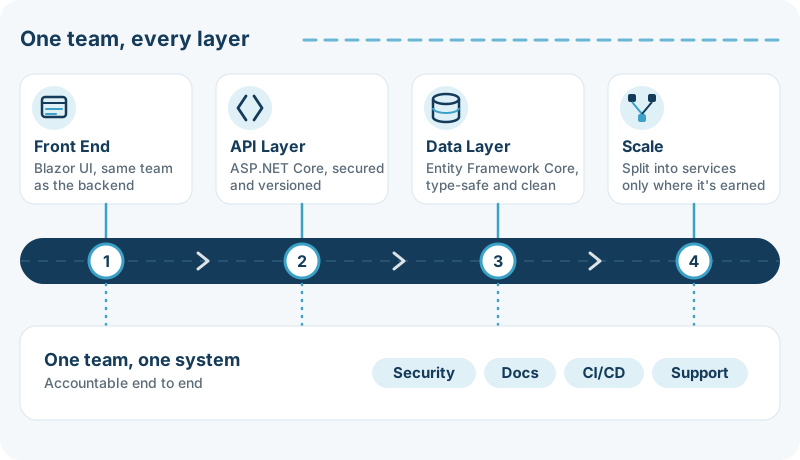
We design, build, and modernize business-critical applications on the Microsoft stack, ASP.NET Core, Blazor, and the data layer underneath them, with one team accountable for the whole system, not a different specialist for every layer.
One accountable team : Front end, API, and data layer built by the same engineers, not handed between vendors.
Security built in, not bolted on : Authentication, authorization, and data protection are part of the build from day one.
Built to scale without a rewrite : Sized for where your business is headed, not just where it is today.
The Problem Most Growing Businesses Run Into
Most Microsoft-stack projects don't fail because the technology was wrong. They fail because the system was assembled piecemeal, one vendor for the front end, another for the API, a freelancer for the database, and nobody responsible for how the pieces hold together once real users show up.
That shows up later as a system that's slow under load, hard to secure, expensive to change, and risky to hand off, because the one person who understood how it all fit together has since moved on. If your team is weighing whether to rebuild, extend, or finally modernize a system your business depends on, that decision deserves a team that owns the outcome, not just the code.
One Team, Accountable for the Whole System
Akantik builds and modernizes enterprise applications across the full Microsoft stack, web applications, internal tools, APIs, and the data layer that ties them together, as a single engagement with a single team. That means fewer handoffs, faster decisions, and nobody pointing at somebody else's layer when something needs to change.
We choose the specific tools, ASP.NET Core, Blazor, a REST API, Entity Framework Core, a microservices split, based on what your business actually needs to solve, not a default stack we reach for on every project.
What We Build
Web applications and internal tools : Built on ASP.NET Core so they run reliably under real traffic and hold up to a real security review, not just a demo.
Interactive front ends in Blazor : The same engineers who build your backend build the interface too, one language, one team, fewer integration bugs between the two.
APIs that other systems can depend on : Secured, documented, and versioned from day one, so a partner or a second internal team can integrate without guesswork.
A data layer that stays maintainable : Built on Entity Framework Core, so your team works with clean, type-safe code instead of hand-written SQL scattered across the codebase.
Systems that scale without a rewrite : Where it genuinely earns its complexity, we break a monolith into independent services so one part of the system can grow without dragging the rest along.
What This Means for Your Business
Faster time to market : One accountable team makes decisions and ships without waiting on approvals from three different vendors.
Lower cost over the system's life : A properly architected system costs less to change a year from now than one that was rushed to meet a launch date.
Security built in, not bolted on : Authentication, authorization, and data protection are part of the build from day one, not a scramble before an audit.
Room to grow without a rebuild : Systems are sized for where your business is headed, not just where it is today, so growth doesn't force a full replacement.
No single point of failure : Documentation and team continuity mean the system doesn't become unmaintainable the day one engineer leaves.
Where This Applies
Customer-facing platforms : Web applications your customers rely on directly, where downtime or a slow page has a real business cost.
Internal operations tools : The systems your own team uses every day to run the business, finance, operations, reporting, that don't get the attention a customer-facing product does but matter just as much.
Legacy application modernization : An older ASP.NET or .NET Framework application that's becoming expensive to maintain and hard to hire for.
Connecting systems that don't talk to each other : A clean API layer that lets your CRM, ERP, and other business systems share data without manual re-entry.
A monolith that's slowing releases down : Breaking out the parts of the system that genuinely need to scale or deploy independently.
Why Businesses Choose Akantik
Full-stack ownership : One team across the front end, the API, and the data layer, so nothing gets lost in a handoff between vendors.
A decade of Microsoft-stack delivery : We've built and supported these systems long enough to know where projects usually go wrong, and to plan around it.
Experience in regulated and enterprise environments : Where getting the architecture or the access controls wrong is expensive to fix after the fact.
Straight answers on scope : If a simpler approach solves your problem, we'll tell you that instead of selling you more than you need.
How We Work
1. Assess : We start with what you actually have, existing code, infrastructure, and constraints, before proposing anything, so the plan is grounded in reality, not a template.
2. Architect : We lay out the approach, what to build, what to keep, what to change, and agree on it with you before writing production code.
3. Build : Development happens in short cycles with visible progress, so you're reviewing working software along the way, not waiting months for a single reveal.
4. Integrate : The system gets connected into your real environment and existing tools, tested against how it will actually be used, not just in isolation.
5. Support : We stay engaged after launch, monitoring, fixes, and adjustments as your business needs change, instead of handing over documentation and disappearing.
The Technology, Briefly
In practice, that means ASP.NET Core for the application layer, Blazor where an interactive web interface makes sense, Entity Framework Core for the data layer, and a microservices split only where the system genuinely needs one. Hosting typically runs on Microsoft Azure, though we build to your existing infrastructure where that's the right call. The technology choice always follows the business requirement, not the other way around.
A Team With a Track Record on This Stack
Akantik has spent 10+ years building and supporting Microsoft-stack applications, across 100+ projects for 200+ clients internationally. That track record is why organizations bring us in for systems that need to hold up, not just launch.
Have a system that needs to be built right, or a legacy application that needs a second look? Let's talk through it.
Built for Security, Process, and Accountability
How we protect your code and keep your project on track when you bring on a dedicated developer or team.
In-House Development
Your developer works as an extension of your own team, inside your codebase, tools, and process, not as a detached offshore unit.
NDA-Backed Confidentiality
Every developer signs an NDA before seeing a line of your code, so your IP stays protected from day one.
Compliance-Aware Development
Code is written and reviewed against your existing security and compliance standards, not a generic checklist bolted on afterward.
Code & Concept Protection
Your source code, architecture, and product concept stay yours, we don't reuse client work across other engagements.
Daily & Weekly Reporting
A consistent update cadence, daily standups or weekly summaries, so progress is visible without you having to chase it.
Agile Delivery
Work is planned and tracked in sprints, so priorities can shift with your roadmap instead of waiting on a fixed-scope contract.
Microsoft & .NET Engineering FAQs
Common questions from business and technology leaders evaluating a Microsoft-stack build or modernization.
Should we build custom on the Microsoft stack, or buy an off-the-shelf platform?
It depends on how central the system is to your business:
- A generic workflow is usually better served by an off-the-shelf tool, faster and cheaper
- A system core to how you operate or compete benefits from a custom build, no licensing constraints, no fitting your process into someone else's product
We'll tell you honestly which side of that line your project falls on before recommending either.
How long does a typical engagement take, from assessment to production?
Timelines depend on scope:
- A focused application: roughly 8 to 12 weeks
- A larger enterprise system or modernization: typically 4 to 9 months
We give you a real timeline after the assessment phase, not before, because committing to a date before understanding the system is how projects run late.
We have an aging .NET Framework or legacy application. How risky is modernizing it?
The risk is manageable when the migration is planned properly:
- We assess what the existing system depends on before anything moves
- Migration happens in phases, not a single high-risk cutover
- A tested rollback path stays in place throughout
Most of the risk in modernization projects comes from skipping the assessment step, not from the technology itself.
What does a project like this typically cost?
Cost depends entirely on scope, a focused internal tool costs a fraction of a customer-facing platform with integrations and compliance requirements.
We scope the engagement against what you actually need and provide a fixed quote after a free consultation.
How do you handle security and compliance requirements like SOC 2, HIPAA, or ISO 27001?
We build security into the architecture from the start:
- Authentication, authorization, and data protection using ASP.NET Core's native security features
- Azure Active Directory and Key Vault where the system runs on Azure
- Technical controls mapped to SOC 2, HIPAA, or ISO 27001 requirements where applicable
Can your team work alongside our in-house developers, or does this have to be a full handoff?
Either works:
- We can embed alongside your existing team to fill a specific gap
- Or take full ownership of a build or modernization from start to finish
We structure the engagement around how much you want to stay involved in day-to-day delivery.
What happens after launch? Do you provide ongoing support?
Yes. We stay engaged after go-live:
- Monitoring performance in production
- Fixes and adjustments as issues surface
- Changes as your business needs evolve
Support doesn't end the day the system ships.