Energy & Utilities
Current Challenges in Energy & Utilities
Energy and utility providers manage assets spread across a wide physical footprint, grid infrastructure, pipelines, plants, substations, that are genuinely hard to monitor in real time. Maintenance on that infrastructure tends to be reactive, a transformer, pipeline, or turbine issue gets discovered after it causes an outage rather than flagged before it does. Regulatory and environmental compliance reporting is heavy and usually assembled by hand from scattered records instead of a system that tracks what's due automatically. Demand forecasting and load balancing get harder every year as renewable generation adds variability that historical averages don't capture well. And because most of this infrastructure runs on legacy SCADA and OT systems that were never designed to share data, getting one integrated view of assets and operations means pulling information from several places by hand.
How Akantik Solves This
We don't ask an energy or utility provider to replace the SCADA and OT systems already running the infrastructure, we build the layer that connects them and makes the data usable. Equipment Lifecycle Management (EquipFlow) tracks the health and maintenance history of grid, pipeline, and plant assets, so a likely failure gets flagged before it causes an outage, not after. Our Compliance Tracking System (CTS) keeps regulatory and environmental documentation, inspections, and certifications in one auditable place with clear due dates, instead of a scramble before a filing deadline. Our AI-Powered ERP ties operations and finance together so a demand shift or a cost spike shows up as a signal instead of a surprise at the end of a billing cycle. And Workflow & Business Automation handles work order dispatch and outage response coordination for field crews, routing the right person to the right issue instead of relying on a phone call and a whiteboard. Every one of these integrates with the SCADA and OT systems already in place, rather than replacing them.
Future Technology & AI for Energy & Utilities
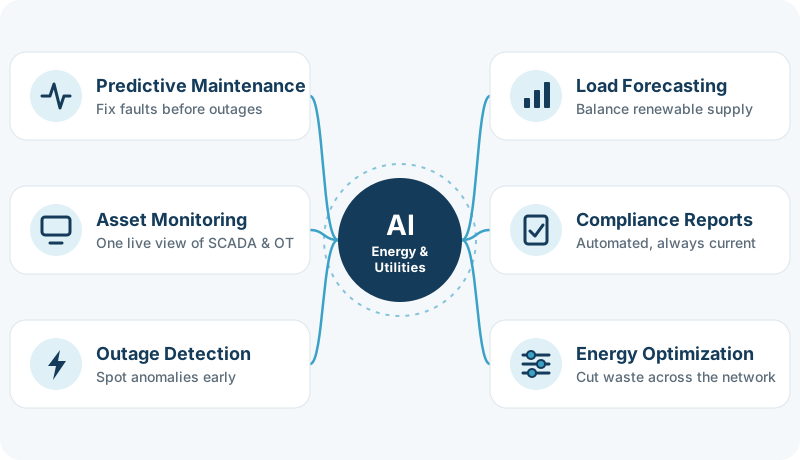
The next step for most energy and utility operations isn't a new plant or grid system, it's putting AI on top of the sensor and asset data those systems already produce. Predictive maintenance models trained on asset and sensor data can flag a likely transformer, pipeline, or turbine failure days before it happens, instead of after it causes an outage. Demand forecasting that accounts for renewable generation variability, not just historical averages, can support better load-balancing decisions as the generation mix keeps shifting. Anomaly detection on operational data can flag a pressure change, a throughput dip, or a cost spike early enough to act on it, before it becomes an incident. Drone and computer-vision based infrastructure inspection can assess line, pipeline, or plant condition at a scale manual inspection can't match. And an AI copilot that a grid or plant operator can simply ask a direct question, such as which substations are showing early signs of load stress, becomes a realistic, buildable tool rather than a slide in a pitch deck.
Tech Stack & Case Studies
Our Tech Stack
Our energy and utilities work runs on the same core platform as the rest of our business, ASP.NET Core and C# on the backend, Angular on the frontend, and SQL Server and Azure for data and hosting, with SCADA and IoT integration layered in wherever a client needs sensor or asset data flowing into the system.
Case Studies
Asset & Equipment Deployments : A recurring engagement for energy and utility clients is applying Equipment Lifecycle Management (EquipFlow) to grid, pipeline, and plant assets, so maintenance history and likely failures are visible ahead of time instead of discovered after an outage.
Compliance & Reporting Deployments : For clients under heavy regulatory and environmental reporting requirements, we've applied the Compliance Tracking System to keep inspections, certifications, and filings in one auditable place with clear due dates, instead of a manual scramble before a deadline.
Other Clients Across Energy & Infrastructure : Beyond energy and utilities specifically, we've applied this same asset-visibility, compliance-tracking, and workflow-automation approach for other clients managing large-scale infrastructure or regulated assets, since the underlying need, connecting distributed assets and legacy systems into one view, holds across the sector.
Finding out about a grid or pipeline issue only after it's caused an outage, or assembling a regulatory report by hand every cycle? Let's fix that.
Energy & Utilities FAQs
Common questions about AI, asset maintenance, and compliance solutions for energy and utility providers.
What energy and utilities problems does Akantik's technology actually solve?
We focus on the problems that cost energy and utility providers the most: reactive maintenance, manual compliance reporting, and disconnected legacy systems. Our EquipFlow, Compliance Tracking System, and AI-Powered ERP are built directly against these.
Do we need to replace our SCADA or OT systems to use Akantik's solutions?
No. Our systems are designed to integrate with your existing SCADA and OT platforms rather than requiring a rip-and-replace.
How does predictive maintenance work for grid or plant infrastructure?
Sensor and asset data train a model to recognize patterns that precede a failure, flagging a problem before it causes an outage.
How does Akantik help with regulatory and environmental compliance?
Our Compliance Tracking System keeps inspections, certifications, and filings in one auditable place with clear due dates.
What kind of energy and utility clients has Akantik worked with?
We've built systems for clients managing large-scale infrastructure and regulated assets, where connecting distributed systems is a core need.
How long does an implementation like this typically take?
It depends on scope, but we deploy in phases, starting with the module that solves your most urgent problem, so you see value before a single, large go-live.