Enterprise Application Modernization
Enterprise Application Modernization
Preserve the business logic your existing application already has, we modernize the architecture, user experience, security, and deployment model around it. No disruption, no lost functionality, no starting over.
Akantik's modernization approach is listed on the Microsoft Marketplace, independent, third-party validation for moving classic Windows and .NET applications to modern Azure-based platforms.
Legacy Application Modernization • Windows & Desktop App Modernization • Monolith to Microservices
Business logic preserved, not rebuilt from scratch : We extract and preserve the rules that took years to get right.
Phased migration, no big-bang cutover : Your team keeps working while the new platform comes online.
Independent, third-party validated : Akantik's modernization approach is listed on the Microsoft Marketplace.
Legacy Application Modernization
Is this you? Running a Windows desktop application that's costly to maintain and hard to hire for. Built on .NET Framework and approaching end of vendor support. Operating on-premise systems that need to move to the cloud without disrupting the business. An ISV planning to turn licensed, on-premise software into a SaaS product.
Comprehensive legacy system evaluation : We assess your existing system in depth to identify what to preserve, what to rebuild, and the migration strategy that fits your business objectives.
Cloud-based infrastructure migration : We migrate legacy systems to secure, scalable cloud platforms such as Microsoft Azure, improving performance, reliability, and security along the way.
Application re-engineering : We modernize applications through code refactoring, re-architecting, and feature enhancements, without losing the business logic already built into them.
Integration with contemporary technologies : Using frameworks like Blazor and ASP.NET Core, we build interactive, responsive applications designed to run on current and future technology platforms.
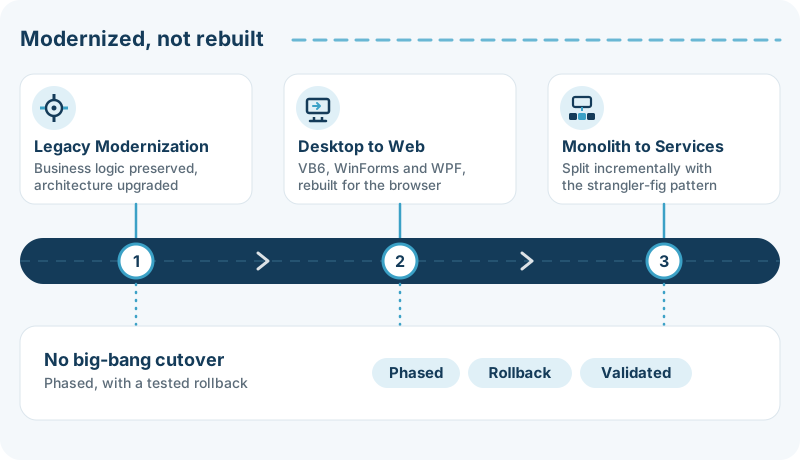
No surprise outages during the switch : We migrate in phases with rollback plans in place, so your team keeps working while the new platform comes online.
Windows & Desktop App Modernization
A Windows Forms or VB6 application that's run the business for fifteen years usually still works, until the one developer who understands it leaves, or it needs a feature the desktop platform can't support. We modernize it without losing the logic that took years to get right, whether you're moving off Windows Forms, WPF, or VB6, to a web application your team can access from anywhere.
Business logic extraction : We document and extract the rules embedded in the existing application, validation logic, calculations, workflow rules, so nothing gets lost in translation to the new platform.
Data migration without disruption : Local databases and file-based storage move to a proper backend, SQL Server, Azure SQL, or another target, with validation so the migrated data matches the source exactly.
A web UI built around real usage : We rebuild the interface in ASP.NET Core or Blazor around real usage patterns, not a literal screen-by-screen copy of a UI designed twenty years ago.
A phased cutover, not a big-bang rewrite : Where possible, we migrate module by module so the team keeps working in the old system while the new one comes online.
Deployment that doesn't depend on a specific machine : The result is a web application your team reaches from any browser, removing the "it only works on that one PC" constraint.
Monolith to Microservices
A monolith that's hard to scale, deploy, or hand off between teams eventually slows every release down. We break applications into independent, scalable services that work together as one system, migrated incrementally using a strangler-fig approach, so the business stays running throughout.
This is the same microservices architecture capability covered in depth on our Microsoft & .NET Engineering page, independent services, resilience, faster time to market, and ongoing support, applied here specifically to decomposing an existing monolith.
The Modernization Journey
Have a legacy application, desktop app, or monolith that's holding your business back? Let's assess what it would take to modernize it.
Enterprise Application Modernization FAQs
Common questions about legacy application, desktop app, and monolith modernization.
What is legacy system migration and why is it important?
Legacy system migration moves applications from outdated platforms to modern architectures. It's important because aging systems become expensive to maintain, pose security risks, and limit business growth.
Can you modernize a VB6 application that's no longer officially supported?
Yes, VB6 modernization is one of the more common projects we take on. We reverse-engineer the business logic from the existing codebase and rebuild it on ASP.NET Core.
Will we lose functionality moving from a desktop app to the web?
No, the goal is functional parity or better. Some desktop-only features (deep OS integration, certain hardware access) may need an alternative approach, which we flag during the assessment.
How does Akantik ensure a smooth migration with minimal downtime?
Akantik follows a phased migration strategy with thorough assessment, parallel running of old and new systems, comprehensive testing, and rollback plans.
Can the migration happen in phases instead of all at once?
In most cases, yes. We migrate module by module where the application's structure allows it, so your team keeps working in the existing system while each piece comes online.
When should my business consider migrating to a microservices architecture?
You should consider microservices when your monolithic application is becoming difficult to scale, deploy, or maintain, or when you need faster release cycles.