Manufacturing & Industrial
Current Challenges in Manufacturing & Industrial
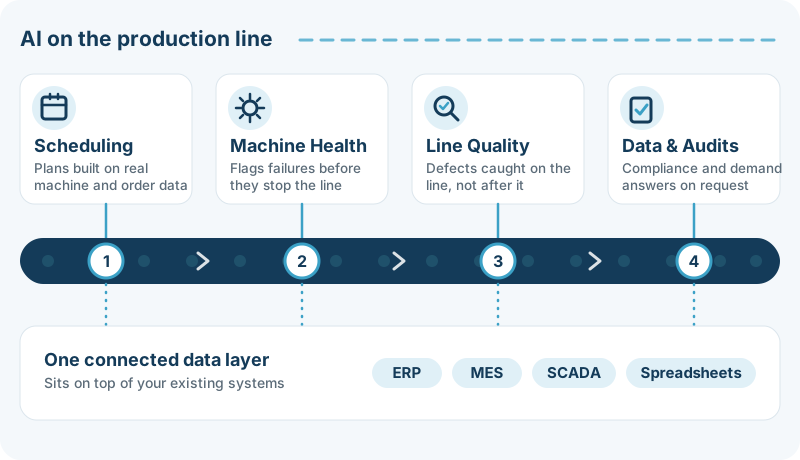
Most manufacturing and industrial operations are fighting the same set of problems, whatever the product on the line. Production schedules get built on gut feel and a whiteboard rather than real machine and order data, so changeovers and bottlenecks aren't caught until they've already cost a shift. Equipment goes down unexpectedly because maintenance is reactive, someone notices a machine has failed rather than a system flagging that it was about to, and that unplanned downtime is one of the most expensive habits on a production line. Quality issues often get caught by an inspector after the fact instead of on the line, which means defective units have already left the station before anyone knew there was a problem. And because most of this still runs on a legacy ERP or a patchwork of spreadsheets, none of it talks to the other systems, so a compliance audit or a sudden demand shift means manually pulling data from several places before anyone can actually act on it.
How Akantik Solves This
We don't ask a manufacturing client to rip out and replace what already works on the floor, we build the layer that connects it and makes it usable. Our Production Management System (PMS) gives planners a real scheduling tool built on actual order priority, machine availability, and changeover time, instead of a whiteboard. Our AI-Powered ERP unifies finance, supply chain, HR, and production into one platform with real-time visibility, so a demand shift or a stock shortage shows up as an alert instead of a surprise at month-end. Equipment Lifecycle Management (EquipFlow) tracks the health and maintenance history of every machine so a likely failure gets flagged before it happens, not after a line goes down. And where compliance and audit tracking is the burden, our Compliance Tracking System (CTS) keeps documentation, inspections, and certifications in one auditable place instead of a filing cabinet or a shared drive. None of these systems is built to stand alone, each one is designed to integrate with the MES, SCADA, and ERP a plant is already running.
Future Technology & AI for Manufacturing
The next step for most plants isn't a new machine, it's making the data those machines already produce actually useful. Predictive maintenance models trained on sensor and machine data can flag a likely failure days before it happens, instead of after a line stops. Computer vision on the production line can catch a defect at full production speed, every shift, instead of relying on a manual inspection that only samples a fraction of output. AI-driven demand and production forecasting gives purchasing and planning a heads-up on a shift in demand before it turns into a shortage or an overstock. And as these systems mature, an AI copilot that a plant manager can simply ask a direct question, such as which line has the highest defect rate this week, becomes a realistic, buildable tool rather than a slide in a pitch deck. We build all of this as an addition on top of the MES, SCADA, and ERP systems already running the floor, not a replacement for them.
Tech Stack & Case Studies
Our Tech Stack
Our manufacturing and industrial work runs on the same stack we use across the business, ASP.NET Core and C# on the backend, Angular on the frontend, and SQL Server and Azure for data and hosting, with Azure IoT and computer-vision tooling layered in wherever a client needs sensor or camera data flowing into the system. That's the same foundation behind our Production Management System, AI-Powered ERP, and Equipment Lifecycle Management (EquipFlow) products, so a manufacturing client isn't getting a one-off build, they're getting a platform we maintain and improve across every client running on it.
Case Studies
Industrial Technology : A manufacturing and industrial client we've worked with on production and operations tooling, the kind of engagement that centers on getting scheduling, machine data, and reporting into one connected system instead of spreadsheets and manual coordination, the same problem our Production Management System and AI-Powered ERP are built to solve.
Industrial Jewels : Another manufacturing and industrial client on our platform, where the focus has been the same core need we see across the sector, keeping production data, equipment status, and reporting connected and visible in one place rather than pieced together after the fact.
Other Manufacturing & Industrial Clients : Beyond these two, we've supported other manufacturing and industrial clients with the same category of need, production scheduling, equipment visibility, and compliance tracking, built on the same core platform rather than a one-off system for every engagement.
Running production on a whiteboard schedule and finding out about equipment failures after they happen? Let's build something that catches it earlier.
Manufacturing & Industrial FAQs
Common questions about AI, ERP, and equipment lifecycle solutions for manufacturing and industrial operations.
What manufacturing problems does Akantik's technology actually solve?
We focus on the problems that cost manufacturers the most: unplanned downtime, manual scheduling, late-caught defects, and disconnected systems. Our PMS, AI-Powered ERP, and EquipFlow are built directly against these.
Do we need to replace our existing ERP or MES to use Akantik's systems?
No. Our systems are designed to integrate with your existing MES, SCADA, and ERP rather than requiring a rip-and-replace.
How does predictive maintenance work in practice?
Sensor and machine data train a model to recognize patterns that precede a failure, flagging a machine before it breaks down instead of after.
Can Akantik integrate with our existing SCADA or PLC systems?
Yes. We connect to your SCADA, PLCs, and MES platforms to pull existing data into the AI and reporting layer without disrupting floor operations.
What kind of manufacturing and industrial clients has Akantik worked with?
We've delivered systems for manufacturing and industrial clients including Industrial Technology and Industrial Jewels, along with other clients across industrial operations.
How long does an implementation like this typically take?
It depends on scope, but we deploy in phases, starting with the module that solves your most urgent problem, so you see value before a single, large go-live.